
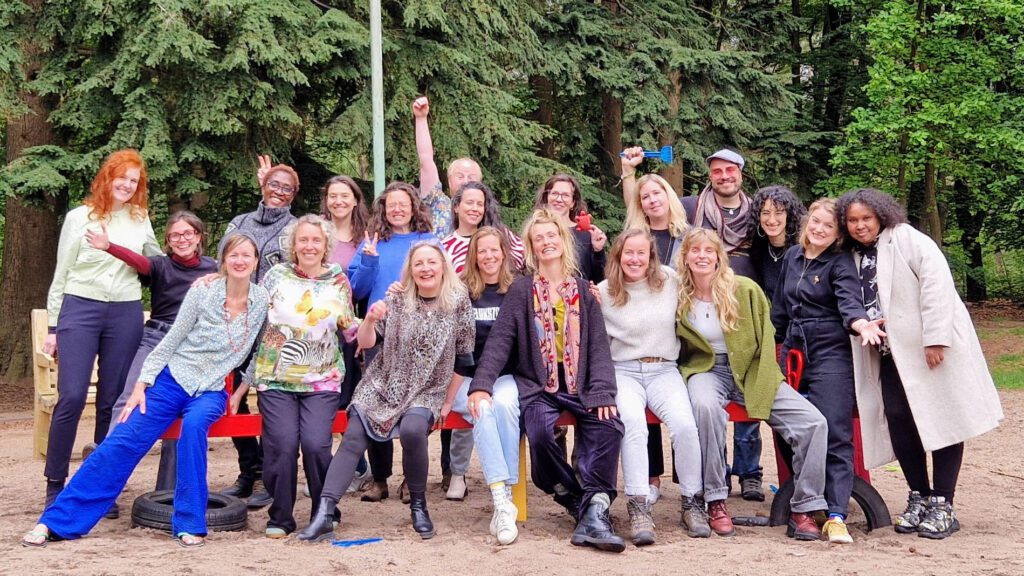
What happens when activists, artists, organisers, dreamers and healers gather not only to resist what is, but to imagine what could be? At Flamingo Collective’s latest flocking in the Netherlands, we came together to make sense of the messy political landscape, dream into feminist futures, and explore healing as a collective practice. We explored how we can build a more feminist, ecological and caring Europe—one rooted in connection, imagination and courage.
By Ioana Banach
Why Do We Gather?
It’s a question we return to before every Flamingo Collective “flocking” – aka physical gatherings, flockings are the special moments when we gather the Flamingo Community to forage for the much needed nutrients for the collective mind, body, soul, propelling ourselves to fly with courage towards new horizons. So why do we gather? In a time of political backlash, shrinking civic space, ecological collapse, war, rising inequality, and collective exhaustion, gathering can feel both essential and insufficient.
And yet.
Again and again, people tell us they are hungry for spaces where they can think deeply, feel honestly, question openly, and imagine collectively. Spaces where they do not have to choose between strategy and soul, analysis and intuition, resistance and creation. Before each flocking, the Flamingo Collective Nest listens carefully to what is moving in the wider community. What conversations are waiting to happen? What questions keep returning? What feels unresolved, neglected or newly possible?
The People We Need, The Conversations We Need
This spring, a group of activists, artists, organisers, researchers, storytellers, funders, singers, healers and dreamers gathered in a forest in the Netherlands for our latest flocking. We came from different countries, movements, traditions and lived experiences. Some arrived energised. Others arrived carrying grief, uncertainty or fatigue. What connected us was a shared commitment to building a more feminist, ecological and caring Europe—and a shared recognition that none of us can do that work alone.
This year, we found ourselves returning to three themes that have accompanied us across previous gatherings: naming the landscape we are traveling through, learning to hold complexity without rushing to certainty, and shifting some of our energy from resistance towards creation.
Or, in “Flamingo language”: learning how to wade through the mud while keeping sight of the horizon.
Dreaming Beyond What We Oppose
Much of movement work is shaped by reacting to crises. We organise against injustice. We respond to attacks. We defend what is under threat. Necessary work. Important work. But it does keep us exactly where the conservative forces want us: reacting to their frame instead of building the new. So what happens when we pause long enough to ask what the roots of the current muck are and imagine what we are actually moving towards?
One of the most powerful moments of the gathering was a collective dreaming session inspired by AWID‘s beautiful feminist futures methodology designed by Fearless Futures Collective. For an afternoon, we stepped away from immediate challenges and into possibility. Participants imagined villages and cities organised around care rather than extraction. Communities where relationships with nature were rooted in reciprocity rather than domination. Places where difference was not something to be managed but something to be celebrated. Futures where love, spirituality, politics, creativity and collective responsibility were no longer separated into different boxes.
What emerged was not a single vision, but a constellation of futures. The exercise reminded us that imagination is not a luxury. It is part of political work. If we cannot imagine alternatives, we risk becoming trapped inside the limits of the systems we are trying to change.
One participant described the experience simply as “remembering the future.”

Healing, Witchiness, and other “Hard Talk”
Every Flamingo Collective gathering includes what has become a community staple: the hard talk. This is where we slow down and make room for the conversations that often struggle to find oxygen. The questions that are uncomfortable, politically sensitive, emotionally charged, or simply difficult to hold in public.
This year, the conversation that emerged was healing. Is healing a precondition for social change? What role does healing play within us, between us, and among us? Can collective transformation happen without collective healing?
The discussion quickly moved beyond the familiar language of self-care and personal growth. Participants challenged the individualised understanding of healing that dominates much contemporary culture—a model that quietly suggests that people must somehow fix themselves before they can contribute to changing the world.
Then, we explored healing as a collective practice. A way of making sense of difficult experiences together. A way of building enough trust to stay in relationship when conflict arises. A way of creating communities capable not only of resisting harm, but of generating belonging, dignity and joy. This is rooted in deep feminist analysis and practice of care as “activity that includes everything that we do to maintain, continue, and repair our ‘world’ so that we can live in it as well as possible. That world includes our bodies, our selves, and our environment, all of which we seek to interweave in a complex, life-sustaining web.” (Tronto & Fischer)
This conversation also touched on something that has surfaced repeatedly in Flamingo spaces: the reclaiming of forms of knowing that have long been dismissed, ridiculed, or excluded from political work. Some participants called this spirituality. Others spoke of intuition, embodiment, ancestral memory, ritual, or deep listening. Some affectionately called it witchiness.
Reflecting back, I wonder whether we are reclaiming witchiness – not as performance or aesthetic, but as a refusal to accept that knowledge only comes through institutions, expertise, data and formal authority. A reminder that we also know things through our bodies. Through dreams. Through stories. Through our relationships with each other and with the living world.
For isn’t reclaiming these ways of knowing a feminist act in itself? After all, the suppression of women’s knowledge, indigenous knowledge, embodied knowledge and spiritual knowledge has always been part of how power operates. To make space for them again is not a retreat from politics. It is politics. Just a complementary way of practising it.
What Are We Deepening
As the gathering came to a close, we reflected on what we’re grateful for.
Many spoke about connection. About finding people who speak truth to power while remaining rooted in care. About feeling nourished by being surrounded by others who refuse cynicism, even when the world gives them plenty of reasons for it.
Others spoke about creativity, beauty, music, poetry, forests, dance and storytelling—not as distractions from movement work, but as part of what sustains it.
One participant said: “This is the village we want to see in the world.”
That sentence has stayed with me. Because perhaps that is what flocking really is. Not an escape from reality. Not a temporary retreat from the challenges we face. But a chance to practise the kinds of relationships, conversations and ways of being that we want to see more of in the world. A chance to remember that systems change is not only about policies, institutions and strategies. It is also about culture. About imagination. About how we relate to one another. About what we choose to nourish.
Flamingos become pink from what they consume. Our movements are not so different. A nice reflection I want to leave you with is: What are you feeding yourself with? And how does that affect which nutrients you are offering to those around you?
Our next gathering will be the on 19 June for Flamingo Collective’s one-year birthday community call, and help us continue imagining—and building—the futures we want to inhabit.